Public Advocate Banner
Home About Press Policy Contact
About the Office
Betsy Gotbaum
Contact
News
Press Releases
Policy
Reports
Reports
Reports
Get Help
How We Can Help
Commission on School Governance
Public Advocate's Blog


Releases & Statements

Gotbaum Finds MetroCards Fail More Than 25% of the Time

In Low Income Areas Failure Rate is as High as 54%

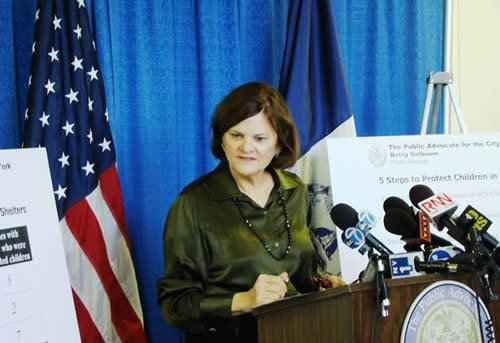
New York City Public Advocate Betsy Gotbaum released a report today revealing that a whopping 28.75 percent of MetroCard swipes at subway turnstiles fail to let the customer through to the platform. At the worst-performing station, the Rockaway Avenue stop along the C line in Ocean Hill/Brownsville, Brooklyn, 54.50 percent of the 3.4 million swipes since 2003 failed to let passengers through. Gotbaum unveiled the report, Stuck at the Turnstile: Failed Swipes Slow Down Subway Riders, in Northern Manhattan at the 116th Street “B” and “C” Train station, which has one of the highest failure rates.

“This is yet another example of the MTA's failure to provide its customers with adequate service. Riders are forced to pay higher fares while facing a host of new problems. The MTA must reduce these swipe failures,” said Gotbaum. The data is based on all 2.5 billion Metrocard swipes that were made since tokens were eliminated in June, 2003. In all, approximately 688,000,000 swipes have failed.

In the worst-performing boroughs, the Bronx and Brooklyn, almost a third of swipes fail. In Manhattan, which has the largest subway ridership, more than a quarter of all swipes fail. The turnstiles and stations with the highest failure rates are mostly in New York City’s low-income neighborhoods, including four stops along the B line: 167th Street in the Bronx, Tremont Avenue in the Bronx, 135th Street in Manhattan, and 116th Street in Manhattan. MetroCard swipes at each of these stops failed between 43 and 45 percent of the time. Swipes at the Nostrand Avenue #3 train stop and the Myrtle-Willoughby G train stop, both in Brooklyn, failed nearly 46 percent of the time.

For the report, Gotbaum’s office used data obtained from New York City Transit (NYCT), the MTA subsidiary which oversees the subway system. The data quantified all the failed and successful swipes. The MTA defines a failed swipe as any swipe that does not produce a complete transaction; however, as Gotbaum's report points out, the MTA fails to identify reasons for these swipe failures.

The report also looked at swipe failures at the subway stations where the MTA plans to phase-out token booths in the coming months. New Yorkers depend on booth attendants for assistance but getting help will be difficult and frustrating with 164 booths closing over the next few months and their attendants instructed to roam around the entire station. "Here is a clear example of how closing token booths hurts New Yorkers: riders whose cards are declined at the turnstile will have difficulty getting help," Gotbaum said.

Gotbaum’s report makes several recommendations to address the failed swipes problem, including the following:

NYCT should update its software to keep track of the different types of error messages at each turnstile-booth area to better determine what maintenance is needed.

Over the next few months, the MTA should carefully examine the effects of its floating attendant program at the turnstiles. If necessary, the MTA should have attendants return to their booths at busy subway stations.

###


Back to top