| Releases & Statements

Contact: Frank
Sobrino, Press Secretary
O:
212.669.4193 ; C: 646.250.4322
For Immediate Release:
February 20, 2006
In an effort to protect
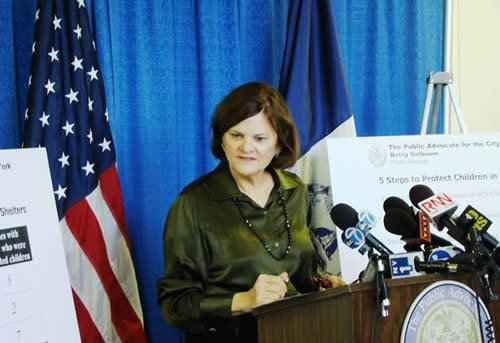
children in foster care from abuse, Public Advocate Betsy Gotbaum
today called for providing city child welfare officials access
to the state's Domestic Violence Registry so they may screen potential
foster and adoptive households for incidents of violence in the
home.
Though more than 1,000
reports of abuse of children in foster care are filed each year
in New York-an average of one every eight hours-the city's Administration
for Children's Services is unable to check the state's database
prior to placing a child because it is not allowed access to the
registry.
"Research tells us that
where there is domestic violence there is very often child abuse,"
Gotbaum said. "It should go without saying that placing a child
in a foster or adoptive home where there is a history of domestic
violence is to put a child's life in jeopardy. Yet state law today
denies ACS the ability to thoroughly screen for domestic violence
when considering foster and adoptive parent applications.
"Action must be taken immediately,"
Gotbaum added. "Defenseless children's lives are at stake."
ACS Commissioner John B.
Mattingly said that, "Children's Services believes it is crucial
to secure legislative authority granting the agency access to
information that would help us conduct more thorough child protective
investigations and foster and adoptive home screenings. We are
very much in favor of Public Advocate Betsy Gotbaum's proposal
to secure Children's Services access to the state's Domestic Violence
Registry to screen potential foster and adoptive households for
incidents of violence in the home."
Assemblymember William
Scarborough, chair of the state assembly's Committee on Children
and Families, has agreed to introduce legislation providing ACS
access to the Domestic Violence Registry.
"Having access to the Registry
would provide Children's Services with information regarding domestic
violence involving birth parents, other adults residing in the
family's home and foster parents," Commissioner Mattingly said. "We
are also working to secure access to the child protective history
of families known to other New York State counties and who subsequently
become known to us."
In addition, Commissioner
Mattingly said Children's Services conducts criminal background
checks of all prospective foster care and adoptive parents. Children's
Services also has developed domestic violence guidelines for foster
care providers, which provide direction for agency staff on how
to screen for domestic violence in the household.
Legislation providing ACS
access to the state's database would need to include appropriate
privacy safeguards, Gotbaum said, ensuring registry information
is used by the agency solely to screen prospective foster and
adoptive parents.
Recognizing that drafting
and passing the necessary state legislation may take weeks, if
not longer, Gotbaum proposed that, in the interim, ACS petition
family court judges to have the Domestic Violence Registry checked
to screen applicants in adoption cases.
Criminal background checks
alone are insufficient, Gotbaum argued, because while they will
reveal criminal convictions for domestic violence, pleas to violations
and dismissals will not turn up, even in cases that resulted in
the issuance of an order of protection against the defendant.
Moreover, a criminal background check will not determine whether
anyone in a prospective foster or adoptive household has been
the subject of a family offense proceeding in civil court.
The Domestic Violence Registry,
on the other hand, includes protection orders issued in both criminal
and civil matters. Only law enforcement and court personnel have
access to the statewide database.
An alternative to providing
ACS direct access to the registry, Gotbaum proposed, is to have
the state Division of Criminal Justice Services review the registry
as part of the criminal background checks of potential foster
and adoptive parents it already conducts. Whether done by the
Division of Criminal Justice Services or by ACS directly, Gotbaum
said either alternative is preferable to the Domestic Violence
Registry not being used at all in the screening of prospective
foster and adoptive homes.
Gotbaum said she would
like to see added to the registry information on orders of protection
issued as a result of child welfare proceedings. Such orders,
issued under Article 10 of the Family Court Act, currently are
not included in the Domestic Violence Registry.
The state's Office of Court
Administration, however, has asked that this information be added
to the registry and both the state senate and assembly have bills
to include the information.
In Fiscal Year 2004, the
most recent year for which city foster care and adoption data
is available, 7,107 children were placed in foster homes or discharged
to adoption. None of the homes into which the children were placed
were checked against the Domestic Violence Registry for incidents
of domestic violence.
"What I am proposing is
not particularly complex, time-consuming or costly to do," Gotbaum
said. "It nonetheless can help save children's lives. I urge our
state legislators to act on this as quickly as possible."
Gotbaum cautioned that
if a prospective foster or adoptive home is rejected because of
information found in the registry, ACS or its contract agencies
must take steps to ensure that the denial does not endanger anyone
in the household.
* * *

|